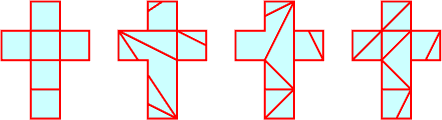
Unfolded Polyhedra
A common way of making models of polyhedra is to unfold the faces into a planar pattern, cut the pattern out of paper, and fold it back up. Is this always possible?
Arranging six squares. This Geometry Forum problem of the week asks for the number of different hexominoes, and for how many of them can be folded into a cube.
The 85 foldings of the Latin cross, E. Demaine et al.
Examples, Counterexamples, and Enumeration Results for Foldings and Unfoldings between Polygons and Polytopes, Erik D. Demaine, Martin L. Demaine, Anna Lubiw, Joseph O'Rourke, cs.CG/0007019.
Find all polytopes. Koichi Hirata's web software for finding all ways of gluing the edges of a polygon so that it can fold into a convex polytope.
Flexagons. Folded paper polyiamonds which can be "flexed" to show different sets of faces. See also Harold McIntosh's flexagon papers, including copies of the original 1962 Conrad-Hartline papers, also mirrored on Erik Demaine's website.
HyperGami program for unfolding polyhedra, also described in this article from the American Scientist.
Knotology. How to form regular polyhedra from folded strips of paper?
MatHSoliD Java animation of planar unfoldings of the Platonic and Archimedean polyhedra.
Models of Platonic solids and related symmetric polyhedra.
New perspective systems, by Dick Termes, an artist who paints inside-out scenes on spheres which give the illusion of looking into separate small worlds. His site also includes an unfolded dodecahedron example you can print, cut, and fold yourself.
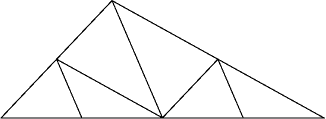
Origamic tetrahedron. The image below depicts a way of making five folds in a 2-3-4 triangle, so that it folds up into a tetrahedron. Toshi Kato asks if you can fold the triangle into a tetrahedron with only three folds. It turns out that there is a unique solution, although many tetrahedra can be formed with more folds.
Pentomino project-of-the-month from the Geometry Forum. List the pentominoes; fold them to form a cube; play a pentomino game. See also proteon's polyomino cube-unfoldings and Livio Zucca's polyomino-covered cube.
Plexagons. Ron Evans proposes to use surfaces made out of pleated hexagons as modular construction units. Paul Bourke explains.
Poly, Windows/Mac shareware for exploring various classes of polyhedra including Platonic solids, Archimedean solids, Johnson solids, etc. Includes perspective views, Shlegel diagrams, and unfolded nets.
Regular 4d polytope foldouts. Java animations by Andrew Weimholt. Also includes some irregular polytops.
Solid object which generates an anomalous picture. Kokichi Sugihara makes models of Escher-like illusions from folded paper. He has plenty more where this one came from, but maybe the others aren't on the web.
Stardust Polyhedron Puzzles. This U.K. company sells unfolded polyhedral puzzles and space-packing shapes (including a nice model of the Weaire-Phelan space-filling foam) on card-stock, to cut out and build yourself.
Stella and Stella4d, Windows software for visualizing regular and semi-regular polyhedra and their stellations in three and four dimensions, morphing them into each other, drawing unfolded nets for making paper models, and exporting polyhedra to various 3d design packages.
Strange unfoldings of convex polytopes, Komei Fukuda, ETH Zurich.
A teacher's guide to building the icosahedron as a class project.
Tessellated polyhedra. Colored unfoldings of the Platonic solids, ready to be printed, cut out, and folded, by Jill Britton.
Tobi Toys sell the Vector Flexor, a flexible cuboctahedron skeleton, and Fold-a-form, an origami business card that folds to form a tetrahedron that can be used as the building block for more complex polyhedra.
Touch-3d, commercial software for unfolding 3d models into flat printouts, to be folded back up again for quick prototyping and mock-ups.
Unfolding convex polytopes. From Jeff Erickson's geometry pages.
Unfolding dodecahedron animation, Rick Mabry.
Unfolding convex polyhedra. Catherine Schevon discusses whether it is always possible to cut a convex polyhedron's edges so its boundary unfolds into a simple planar polygon. Dave Rusin's known math pages include another article by J. O'Rourke on the same problem.
Unfolding some classes of orthogonal polyhedra, Biedl, Demaine, Demaine, Lubiw, Overmars, O'Rourke, Robbins, and Whitesides, CCCG 1998.
Unfolding the tesseract. Peter Turney lists the 261 polycubes that can be folded in four dimensions to form the surface of a hypercube, and provides animations of the unfolding process.
Unfurling crinkly shapes. Science News discusses a recent result of Demaine, Connelly, and Rote, that any nonconvex planar polygon can be continuously unfolded into convex position.
When can a polygon fold to a polytope? A. Lubiw and J. O'Rourke describe algorithms for finding the folds that turn an unfolded paper model of a polyhedron into the polyhedron itself. It turns out that the familiar cross hexomino pattern for folding cubes can also be used to fold three other polyhedra with four, five, and eight sides.