Sphere Packing and Kissing Numbers
Problems of arranging balls densely arise in many situations, particularly in coding theory (the balls are formed by the sets of inputs that the error-correction would map into a single codeword).
The most important question in this area is Kepler's problem: what is the most dense packing of spheres in space? The answer is obvious to anyone who has seen grapefruit stacked in a grocery store, but a proof remains elusive. (It is known, however, that the usual grapefruit packing is the densest packing in which the sphere centers form a lattice.)
The colorfully named "kissing number problem" refers to the local density of packings: how many balls can touch another ball? This can itself be viewed as a version of Kepler's problem for spherical rather than Euclidean geometry.
1st and 2nd Ajima-Malfatti points. How to pack three circles in a triangle so they each touch the other two and two triangle sides. This problem has a curious history, described in Wells' Penguin Dictionary of Curious and Interesting Geometry: Malfatti's original (1803) question was to carve three columns out of a prism-shaped block of marble with as little wasted stone as possible, but it wasn't until 1967 that it was shown that these three mutually tangent circles are never the right answer. See also this Cabri geometry page, the MathWorld Malfatti circles page, and the Wikipedia Malfatti circles page.
Algorithmic packings compared. Anton Sherwood looks at deterministic rules for disk-packing on spheres.
Apollonian Gasket, a fractal circle packing formed by packing smaller circles into each triangular gap formed by three larger circles. From MathWorld.
Basic crystallography diagrams, B. C. Taverner, Witwatersrand.
The charged particle model: polytopes and optimal packing of p points in n dimensional spheres.
Circle packing and discrete complex analysis. Research by Ken Stephenson including pictures, a bibliography, and downloadable circle packing software.
Circle packings. Gareth McCaughan describes the connection between collections of tangent circles and conformal mapping. Includes some pretty postscript packing pictures.
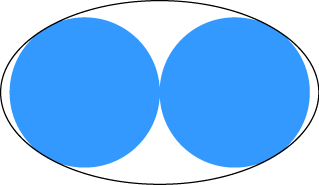
Circles in ellipses. James Buddenhagen asks for the smallest ellipse that contains two disjoint unit circles. Discussion continued in a thread on three circles in an ellipse.
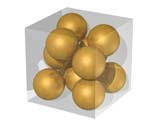
Densest packings of equal spheres in a cube, Hugo Pfoertner. With nice ray-traced images of each packing. See also Martin Erren's applet for visualizing the sphere packings.
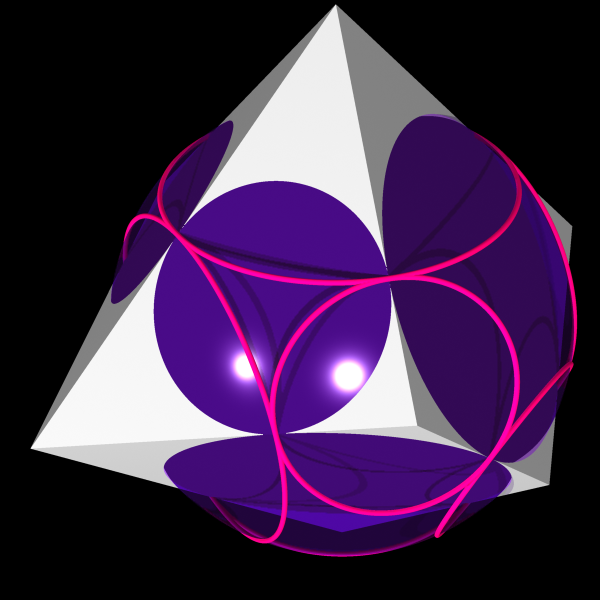
Edge-tangent polytope illustrating Koebe's theorem that any planar graph can be realized as the set of tangencies between circles on a sphere. Placing vertices at points having those circles as horizons forms a polytope with all edges tangent to the sphere. Rendered by POVray.
Erich's Packing Page. Erich Friedman enjoys packing geometric shapes into other geometric shapes.
Figure eight knot / horoball diagram. Research of A. Edmonds into the symmetries of knots, relating them to something that looks like a packing of spheres. The MSRI Computing Group uses another horoball diagram as their logo.
The fractal art of Wolter Schraa. Includes some nice reptiles and sphere packings.
Hermite's constants. Are certain values associated with dense lattice packings of spheres always rational? Part of Mathsoft's collection of mathematical constants.
Improved dense packing of equal disks in a square, D. Boll et al., Elect. J. Combinatorics.
The Kepler Conjecture on dense packing of spheres.
Kissing numbers. Eric Weisstein lists known bounds on the kissing numbers of spheres in dimensions up to 24.
Maximizing the minimum distance of N points on a sphere, ray-traced by Hugo Pfoertner.
Measurement sample. Ed Dickey advocates teaching about sphere packings and kissing numbers to high school students as part of a teaching strategy involving manipulative devices.
Min-energy configurations of electrons on a sphere, K. S. Brown.
Maximum volume arrangements of points on a sphere, Hugo Pfoertner.
Optimal illumination of a sphere. An interesting variation on the problem of equally spacing points, by Hugo Pfoertner.
Packing circles in circles and circles on a sphere, Jim Buddenhagen. Mostly about optimal packing but includes also some nonoptimal spiral and pinwheel packings.
Packing circles in the hyperbolic plane, Java animation by Kevin Pilgrim illustrating the effects of changing radii in the hyperbolic plane.
Packing pennies in the plane, an illustrated proof of Kepler's conjecture in 2D by Bill Casselman.
Packing results, D. Boll. C code for finding dense packings of circles in circles, circles in squares, and spheres in spheres.
Pennies in a tray, Ivars Peterson.
Pentagon packing on a circle and on a sphere, T. Tamai.
Points on a sphere. Paul Bourke describes a simple random-start hill-climbing heuristic for spreading points evenly on a sphere, with pretty pictures and C source.
Satellite constellations. Sort of a dynamic version of a sphere packing problem: how to arrange a bunch of satellites so each point of the planet can always see one of them?
Oded Schramm's mathematical picture gallery primarily concentrating in square tilings and circle packings, many forming fractal patterns.
N. J. A. Sloane's netlib directory includes many references and programs for sphere packing and clustering in various models. See also his list of sphere-packing and lattice theory publications.
Soddy's Hexlet, six spheres in a ring tangent to three others, and Soddy's Bowl of Integers, a sphere packing combining infinitely many hexlets, from Mathworld.
Sphere distribution problems. Page of links to other pages, collected by Anton Sherwood.
Spheres and lattices. Razvan Surdulescu computes sphere volumes and describes some lattice packings of spheres.
Spheres with colorful chickenpox. Digana Swapar describes an algorithm for spreading points on a sphere to minimize the electrostatic potential, via a combination of simulated annealing and conjugate gradient optimization.
Spontaneous patterns in disk packings, Lubachevsky, Graham, and Stillinger, Visual Mathematics. A procedure for packing unit disks into square containers produces large grains of hexagonally packed disks with sporadic rattlers along the grain boundaries.
Waterman polyhedra, formed from the convex hulls of centers of points near the origin in an alternating lattice. See also Paul Bourke's Waterman Polyhedron page.