
Polyominoes and Other Animals
Connected subsets of the square lattice tiling of the plane are called polyominoes. These are often classified by their number of squares, so e.g. a tetromino has four squares and a pentomino has five; this nomenclature is by analogy to the word "domino" (a shape formed by two connected squares, but unrelated in etymology to the roots for "two" or "square").
If a polyomino or a higher-dimensional collection of cubes forms a shape topologically equivalent to a ball, it is called an animal. A famous open problem asks whether any animal in three dimensions can be transformed into a single cube by adding and removing cubes, at each step remaining an animal (it is known that removal alone does not always work). Other related figures include polyiamonds (collections of equilateral triangles), polyabolos (collections of half-squares), and polyhexes (collections of regular hexagons).
Anna's pentomino page. Anna Gardberg makes pentominoes out of sculpey and agate.
Arranging six squares. This Geometry Forum problem of the week asks for the number of different hexominoes, and for how many of them can be folded into a cube.
Blocking polyominos. R. M. Kurchan asks, for each k, what is the smallest polyomino such that k copies can form a "blocked" configuration in which no piece can be slid free of the others, but in which any subconfiguration is not blocked.
Canonical polygons. Ronald Kyrmse investigates grid polygons in which all side lengths are one or sqrt(2).
Counting polyforms, with links to images of various packing-puzzle solutions.
Covering the Aztec diamond with one-sided tetrasticks, A. Wassermann.
Dancing links. Don Knuth discusses implementation details of polyomino search algorithms.
A dissection puzzle. T. Sillke asks for dissections of two heptominoes into squares, and of a square into similar triangles.
Equilateral pentagons. Jorge Luis Mireles Jasso investigates these polygons and dissects various polyominos into them.
Eternity puzzle made from "polydrafters", compounds of 30-60-90 triangles. See also the mathpuzzle eternity page.
Flexagons. Folded paper polyiamonds which can be "flexed" to show different sets of faces. See also Harold McIntosh's flexagon papers, including copies of the original 1962 Conrad-Hartline papers, also mirrored on Erik Demaine's website.
Golygons, polyominoes with consecutive integer side lengths. See also the Mathworld Golygon page.
Happy cubes and other three-dimensional polyomino puzzles.
Happy Pentominoes, Vincent Goffin.
Harary's animal game. Chris Thompson asks about recent progress on this generalization of tic-tac-toe and go-moku in which players place stones attempting to form certain polyominoes.
Heesch's problem. How many times can a shape be completely surrounded by copies of itself, without being able to tile the entire plane? W. R. Marshall and C. Mann have recently made significant progress on this problem using shapes formed by indenting and outdenting the edges of polyhexes.
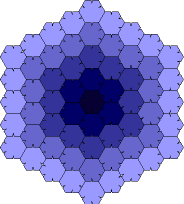
Heptomino Packings. Clive Tooth shows us all 108 heptominos, packed into a 7x9x12 box.
Hinged dissections of polyominoes.

George Huttlin's Puzzle Page. Some ramblings in the world of polyominoes and hexiamonds.
Information on Pentomino Puzzles and Information on Polyominoes, from F. Ruskey's Combinatorial Object Server.
Interlocking Puzzles LLC are makers of hand crafted hardwood puzzles including burrs, pentominoes, and polyhedra.
Isoperimetric polygons. Livio Zucca groups grid polygons by their perimeter instead of by their area. For small integer perimeter the results are just polyominos but after that it gets more complicated...
Jacqui's Polyomino Workshop. Activities associated with polyominoes, aimed at the level of primary (or elementary) school mathematics.
Java pentomino puzzle solver, D. Eck, Hobart and William Smith Colleges.
Iwan Jensen counts polyominos (aka lattice animals), paths, and various related quantities.
Kadon Enterprises, makers of games and puzzles including polyominoes and Penrose tiles.
Knight's Move Tessellations. Dan Thomasson looks at tilings with polygons that can be traced out by knight moves on a chessboard.
Lattice animal constant. What is the asymptotic behavior of the number of n-square polyominos, as a function of n? From MathSoft's favorite constants pages.
Lego Pentominos, Eric Harshbarger. He writes that the hard part was finding legos in enough different colors. See also his Lego math puzzles and pentominoes pages.
LiveCube polycube puzzle building toy.
Logical art and the art of logic, pentomino art, philosophy, and DOS software, G. Albrecht-Buehler.
Magazine Puzzle Fun. Fifteen years of back issues of an Argentine magazine about pentominoes (in English).
The mathematics of polyominoes, K. Gong. Counts of k-ominoes, Macintosh polyomino software, and more links.
Maximum convex hulls of connected systems of segments and of polyominoes. Bezdek, Brass, and Harborth place bounds on the convex area needed to contain a polyomino.
The MindBlock. Reassemble a chessboard cut into twelve interlocking polyominos.
A minimal domino tiling. How small a square board can one fill with dominos in a way that can't be separated into two smaller rectangles? From Stan Wagon's PotW archive.
Miscellaneous polyomino explorations. Alexandre Owen Muniz looks at double polyomino tilings that simultaneously cover all half-grid edges, magic polyominoes, and more.
Odd rectangles for L4n+2. Phillippe Rosselet shows that any L-shaped (4n+2)-omino can tile a rectangle with an odd side.
Packing Ferrers Shapes. Alon, Bóna, and Spencer show that one can't cover very much of an n by p(n) rectangle with staircase polyominoes (where p(n) is the number of these shapes).
Packing polyominoes. Mark Michell investigates the problem of arranging pentominoes into rectangles of various (non-integer) aspect ratios, in order to saw the largest possible pieces from a given size piece of wood.
Pairwise touching hypercubes. Erich Friedman asks how to partition the unit cubes of an a*b*c-unit rectangular box into as many connected polycubes as possible with a shared face between every pair of polycubes. He lists both general upper and lower bounds as functions of a, b, and c, and specific constructions for specific sizes of box. I've seen the same question asked for d-dimensional hypercubes formed out of 2^d unit hypercubes; there is a lower bound of roughly 2d/2 (from embedding a 2*2d/2*2d/2 box into the hypercube) and an upper bound of O(2d/2 sqrt d) (from computing how many cubes must be in a polycube to give it enough faces to touch all the others).
Pentamini. Italian site on pentominoes, by L. Zucca.
Pentomino. Extensive website on polyomino problems, developed by secondary school students in Belgium. Includes regular prize contest problems involving maximizing the area enclosed by polyominos in various ways.
The Pentomino Dictionary and other oulipian exercises, G. Esposito-Farèse. The twelve pentominoes resemble letters; what words do they spell? Also includes sections on "perecquian" configurations and a pentomino jigsaw puzzle.
Pentomino dissection of a square annulus. From Scott Kim's Inversions Gallery.
Pentomino project-of-the-month from the Geometry Forum. List the pentominoes; fold them to form a cube; play a pentomino game. See also proteon's polyomino cube-unfoldings and Livio Zucca's polyomino-covered cube.
Pento - A Program to Solve the Pentominoes Problem. Sean Vyain.
Pento pentomino solving software from Amamas Software.
Pentomino HungarIQa. What happens to standard pentomino puzzles and games if you use poly-rhombs instead of poly-squares?
Pentomino relationships. A. Smith classifies pentomino packings according to their shared subpatterns.
Pentominoes - an introduction. From the Centre for Innovation in Mathematics Teaching.
Lorente Philippe's pentomino homepage. In French.
The Poly Pages. Andrew L. Clarke provides information and links on the various polyforms.
PolyB Unix software for enumerating lattice animals, Paul Janssens.
Polygon Puzzle open source polyomino and polyform placement solitaire game.
Polyforms. Ed Pegg Jr.'s site has many pages on tiling, packing, and related problems involving polyominos, polyiamonds, polyspheres, and related shapes.
Polyiamond exclusion. Colonel Sicherman asks what fraction of the triangles need to be removed from a regular triangular tiling of the plane, in order to make sure that the remaining triangles contain no copy of a given polyiamond.
Polyiamonds. This Geometry Forum problem of the week asks whether a six-point star can be dissected to form eight distinct hexiamonds.
Polyomino applet, Wil Laan.
Polyomino covers. Alexandre Owen Muniz investigates the minimum size of a polygon that can contain each of the n-ominoes.
Polyomino enumeration, K. S. Brown.
Polyomino inclusion problem. Yann David wants to know how to test whether all sufficiently large polyominoes contain at least one member of a given set.
Polyomino problems and variations of a theme. Information about filling rectangles, other polygons, boxes, etc., with dominoes, trominoes, tetrominoes, pentominoes, solid pentominoes, hexiamonds, and whatever else people have invented as variations of a theme.
Polyomino tiling. Joseph Myers classifies the n-ominoes up to n=15 according to how symmetrically they can tile the plane.
Polyominoes 7.0 Macintosh shareware.
Polyominoids, connected sets of squares in a 3d cubical lattice. Includes a Java applet as well as non-animated description. By Jorge L. Mireles Jasso.
Polypolygon tilings, S. Dutch.
Primes of a 14-omino. Michael Reid shows that a 3x6 rectangle with a 2x2 bite removed can tile a (much larger) rectangle. It is open whether it can do this using an odd number of copies.
Proteon's Puzzle Notes Wen-Shan Kao covers cubes with polyominos and polysticks, packs worms into boxes, and studies giant tangram like puzzles.
Puzzle Fun, a quarterly bulletin edited by R. Kurchan about polyominoes and other puzzles.
Puzzles by Eric Harshbarger, mostly involving colors of and mazes on polyhedra and polyominoes.
Puzzling paper folding. An amusing origami polyabolo eversion puzzle.
Random domino tiling of an Aztec diamond and other undergrad research on random tiling.
Reproduction of sexehexes. Livio Zucca finds an interesting fractal polyhex based on a simple matching rule.
A simple dodecahedron tiling puzzle. Cover the dodecahedron's faces with pentagonal tetrominos.
A small puzzle. Joe Fields asks whether a certain decomposition into L-shaped polyominoes provides a universal solution to dissections of pythagorean triples of squares.
Solution to the pentomino problem by pete@bignode.equinox.gen.nz, from the rec.puzzles archives.
The soma cube page and pentomino page, J. Jenicek.
sqfig and sqtile, software by Eric Laroche for generating polyominoes and polyomino tilings.
Square Knots. This article by Brian Hayes for American Scientist examines how likely it is that a random lattice polygon is knotted.
Tesselating locking polyominos, Bob Newman.
This is your brain on Tetris. Are pentominos really "an ancient Roman puzzle"?
The three dimensional polyominoes of minimal area, L. Alonso and R. Cert, Elect. J. Combinatorics.
Three nice pentomino coloring problems, Owen Muniz.
A tiling from ell. Stan Wagon asks which rectangles can be tiled with an ell-tromino.
Tiling the infinite grid with finite clusters. Mario Szegedy describes an algorithm for determining whether a (possibly disconnected) polyomino will tile the plane by translation, in the case where the number of squares in the polyomino is a prime or four.
The tiling puzzle games of OOG. Windows and Java software for tangrams, polyominoes, and polyhexes.
Tiling rectangles and half strips with congruent polyominoes, and Tiling a square with eight congruent polyominoes, Michael Reid.
Tiling stuff. J. L. King examines problems of determining whether a given rectangular brick can be tiled by certain smaller bricks.
Tiling with four cubes. Torsten Sillke summarizes results and conjectures on the problem of tiling 3-dimensional boxes with a tile formed by gluing three cubes onto three adjacent faces of a fourth cube.
Tiling with notched cubes. Robert Hochberg and Michael Reid exhibit an unboxable reptile: a polycube that can tile a larger copy of itself, but can't tile any rectangular block.
Tiling with polyominos. Michael Reid summarizes results on the ability to cover rectangles and other figures using polyominoes. See also Torsten Sillke's page of results on similar problems.
Tilings. Lecture notes from the Clay Math Institute, by Richard Stanley and Federico Ardila, discussing polyomino tilings, coloring arguments for proving the nonexistence of tilings, counting how many tilings a region has, the arctic circle theorem for domino tilings of diamonds, tiling the unit square with unit-fraction rectangles, symmetry groups, penrose tilings, and more. In only 21 pages, including the annotated bibliography. A nice but necessarily concise introduction to the subject. (Via Andrei Lopatenko.)
Triangular polyhex tilings. What is the smallest equilateral triangle that can be tiled by a given polyhex?
Unbalanced anisohedral tiling. Joseph Myers and John Berglund find a polyhex that must be placed two different ways in a tiling of a plane, such that one placement occurs twice as often as the other.
Unbeatable Tetris. Java demonstration that this tetromino-packing game is a forced win for the side dealing the tetrominoes.
Unfolding the tesseract. Peter Turney lists the 261 polycubes that can be folded in four dimensions to form the surface of a hypercube, and provides animations of the unfolding process.
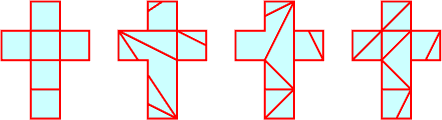
When can a polygon fold to a polytope? A. Lubiw and J. O'Rourke describe algorithms for finding the folds that turn an unfolded paper model of a polyhedron into the polyhedron itself. It turns out that the familiar cross hexomino pattern for folding cubes can also be used to fold three other polyhedra with four, five, and eight sides.
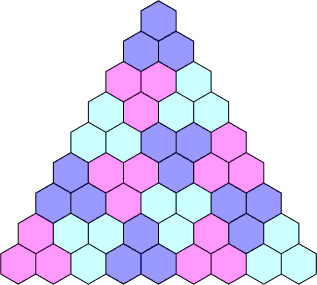
A word problem. Group theoretic mathematics for determining whether a polygon formed out of hexagons can be dissected into three-hexagon triangles, or whether a polygon formed out of squares can be dissected into restricted-orientation triominoes.
Xominoes. Livio Zucca finds a set of markings for the edges of a square that lead to exactly 100 possible tiles, and asks how to fit them into a 10x10 grid.