
Geometric Models
This page describes physical objects corresponding to geometric constructions (and methods for creating such objects), particularly polytopes. See also the origami page, for models made of folded paper, and the toys page, for some commercially-available geometric model construction kits.
Acme Klein Bottle. A topologist's delight, handcrafted in glass.
Anna's pentomino page. Anna Gardberg makes pentominoes out of sculpey and agate.
Art, Math, and Computers -- New Ways of Creating Pleasing Shapes, C. Séquin, Educator's TECH Exchange, Jan. 1996.
The Art and Science of Tiling. Penrose tiles at Carleton College.
Art at the 2005 Joint Mathematics Meetings, including many geometric models.
Art of the Tetrahedron. And by "Art" he means "Arthur". Arthur Silverman's geometric sculpture, from Ivars Peterson's MathTrek.
The Atomium, structure formed for Expo 1958 in the form of nine spheres, representing an iron crystal. The world's largest cube?
Belousov's Brew. A recipe for making spiraling patterns in chemical reactions.
Beyond the Möbius strip. Construction templates for paper models of Möbius-related three-dimensional surfaces.
Constructing Boy's surface out of paper and tape.
Crocheted Seifert surfaces by Matthew Wright. George Hart, Make Magazine.
Crop circles: theorems in wheat fields. Various hoaxers make geometric models by trampling plants.
The downstairs half bath. Bob Jenkins decorated his bathroom with ceramic and painted pentagonal tiles.
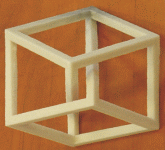
Escher for real and beyond Escher for real. Gershon Elber uses layered manufacturing systems to build 3d models of Escher's illusions. The trick is to make some seemingly-flat surfaces curve towards and away from the viewplane.
Helaman Ferguson mathematical sculpture.
Fisher Pavers. A convex heptagon and some squares produce an interesting four-way symmetric tiling system.
Flat equilateral tori. Can one build a polyhedral torus in which all faces are equilateral triangles and all vertices have six incident edges? Probably not but this physical model comes close.
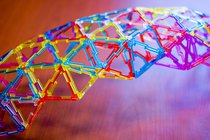
Fun with Fractals and the Platonic Solids. Gayla Chandler places models of polyhedra and polyhedral fractals such as the Sierpinski tetrahedron in scenic outdoor settings and photographs them there.
Gaudí's geometric models. From the Gaudí museum in Parc Güell, Barcelona.
Geometrinity, geometric sculpture by Denny North.
Graphite with growth spirals on the basal pinacoids. Pretty pictures of spirals in crystals. (A pinacoid, it turns out, is a plane parallel to two crystallographic axes.)
Great triambic icosidodecahedron quilt, made by Mark Newbold and Sarah Mylchreest with the aid of Mark's hyperspace star polytope slicer.
Melinda Green's geometry page. Green makes models of regular sponges (infinite non-convex generalizations of Platonic solids) out of plastic "Polydron" pieces.
Bradford Hansen-Smith makes geometric art out of paper plates.
Houtrust Relief. Nice photo of a 3d version of one of Escher's bird-fish textures, on the wall of a water purifying plant in The Netherlands. The same photographer has several other Escher photos including one of Metamorphoses in the Hague post office.
Hyperbolic crochet coral reef, the Institute for Figuring. Daina Taimina's technique for crocheting yarn into hyperbolic surfaces forms the basis for an exhibit of woolen undersea fauna and flora.
Hyperbolic shortbread. The Davis math department eats a Poincaré model of a tiling of the hyperbolic plane by 0-60-90 triangles.
The hyperbolic surface activity page. Tom Holroyd describes hyperbolic surfaces occurring in nature, and explains how to make a paper model of a hyperbolic surface based on a tiling by heptagons.
HyperGami gallery. Paper polyhedral penguins, pinapples, pigs, and more.
Aaron Kellner Linear Sculpture. Art in the form of geometric tangles of metal and wood rods.
Lego Pentominos, Eric Harshbarger. He writes that the hard part was finding legos in enough different colors. See also his Lego math puzzles and pentominoes pages.
Mathematical balloon twisting. Vi Hart makes polyhedra and polyhedral tangles from balloons.
Mathematical lego sculptures and Escher Lego, Andrew Lipson.
Mathematically correct breakfast. George Hart describes how to cut a single bagel into two linked Möbius strips. As a bonus, you get more surface area for your cream cheese than a standard sliced bagel.
Mathematics in John Robinson's symbolic sculptures. Borromean rings, torus knots, fiber bundles, and unorientable geometries.
A minimal winter's tale. Macalester College's snow sculpture of Enneper's surface wins second place at Breckenridge.
Möbius at the Shopping Mall. Topological sculpture as public seating. From MathTrek.
Models of Mathematical Machines at the University Museum of Natural Science and Scientific Instruments of the University of Modena. Main exhibit is in Italian but there is an English preface and htm.
Models of Platonic solids and related symmetric polyhedra.
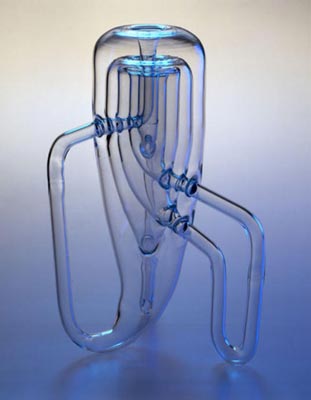
Nested Klein bottles. From the London Science Museum gallery, by way of Boing Boing. Topological glassware by Alan Bennett.
Penrose quilt on a snow bank, M.&S. Newbold. See also Lisbeth Clemens' Penrose quilt.
Pentagonal coffee table with rhombic bronze casting related to the Penrose tiling, by Greg Frederickson.
Plato, Fuller, and the three little pigs. Paul Flavin makes tensegrity structures out of ball point pens and rubber bands.
Popsicle stick bombs, lashings and weavings in the plane, F. Saliola.
Quark Park. An ephemeral outdoor display of geometric art, in Princeton, New Jersey. From Ivars Peterson's MathTrek.
Ram's Horn cardboard model of an interesting 3d spiral shape bounded by a helicoid and two nested cones.
Regard mathématique sur Bruxelles. Student project to photograph city features of mathematical interest and model them in Cabri.
Robinson Friedenthal polyhedral explorations. Geometric sculpture.
Rubik's Cube Menger Sponge, Hana Bizek.
Santa Rosa Menger Cube made by Tom Falbo and helpers at Santa Rosa Junior College from 8000 1-inch-cubed oak blocks.
Sierpinski cookies. Actually more like Menger cookies, but whatever.
The Sierpinski Tetrahedron, everyone's favorite three dimensional fractal. Alexander Graham Bell made kites in this shape, and it has been a frequent construction of geometric model-makers ever since.
Sliceforms, 3d models made by interleaving two directions of planar slices.
sneJ made a Mandelbrot set with sheet plastic and a laser cutter.
Solid object which generates an anomalous picture. Kokichi Sugihara makes models of Escher-like illusions from folded paper. He has plenty more where this one came from, but maybe the others aren't on the web.
Solving the Petersen Graph Zome Challenge. David MacMahon discovers that there is no way to make a non-self-intersecting peterson graph with Zome tool. Includes VRML illustrations.
The sphericon, a convex shape with one curved face and two semicircular edges that can roll with a wobbling motion in a straight line. See also the national curve bank sphericon page, the MathWorld sphericon page, the Wikipedia sphericon page, The Differential Geometry of the Sphericon, and building a sphericon.
Spiral tea cozy, Kathleen Sharp.
Spiral tower. Photo of a building in Iraq, part of a web essay on the geometry of cyberspace.
Steve's sprinklers. An interesting 3d polygon made of copper pipe forms various symmetric 2d shapes when viewed from different directions.
Temari dodecahedrally decorated Japanese thread ball. See also Summer's temari gallery for many more.
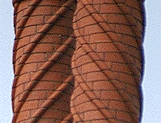
These two pictures by Richard Phillips are from the now-defunct maths with photographs website. The chimney is (Phillips thinks) somewhere in North Nottinghamshire, England. A similar collection of Phillips' mathematical photos is now available on CD-ROM.
Three spiral tattoos from the Discover Magazine Science Tattoo Emporium.
Triangle table by Theo Gray, displaying the Spieker Circle of the 3-4-5 right triangle.
Federation Square. This building in Melbourne uses the pinwheel tiling as a design motif. Thanks to Khalad Karim for identifying it. Photos by Dick Hess, scanned by Ed Pegg Jr. See this Flickr photopool for many more photos.


Vasarely Design. Hana Bizek makes geometric sculptures from Rubik's cubes.
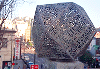
Vegreville, Alberta, home of the world's largest easter egg. Designed by Ron Resch, based on a technique he patented for folding paper or other flat construction materials into flexible surfaces.
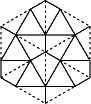
Voronoi Art. Scott Sona Snibbe uses a retro-reflective floor to display the Voronoi diagram of people walking on it, exploring notions of personal space and individual-group relations. Additional Voronoi-based art is included in his dynamic systems series.
Voronoi diagrams at the Milwaukee Art Museum. Scott Snibbe's artwork Boundary Functions, as blogged by Quomodumque.
vZome zometool design software for OS X and Windows. (Warning, web site may be down on off-hours.)
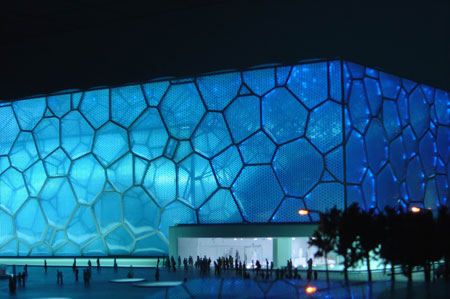
The Water Cube swimming venue at the 2008 Beijing Olympics uses the Weaire-Phelan foam (a partition of 3d space into equal-volume cells with the minimum known surface area per unit volume) as the basis of its structure.
What to make with golf balls? Dale Seymour chooses a Sierpinski triangle and Sierpinski tetrahedron.
Woolly thoughts, mathematical knitwear.
Zonohedron Beta. A flexible polyhedron model made by Bathsheba Grossman out of aluminum, stainless steel, and brass (bronze optional). Also see the rest of Grossman's geometric sculpture.

